Showing posts with label Customer Management. Show all posts

Monday, September 30, 2013

Egg Baskets

Eggs In Basket
When I was young, I had a best friend, Jimmy.  I spent most of my time playing with Jimmy.  We'd catch grasshoppers in the vacant lot, build forts in the strangest places, and and ride our bikes everywhere we could and a few places we couldn't.

Then one summer, something changed.  I didn't realize something had changed until Jimmy stood me up at the bus to go to the city pool for the third time. It bothered me when I realized that Jimmy just didn't show up instead of telling me that he didn't want to go to the pool.

While it hurt a little that Jimmy had found other friends, the larger problem was that I spent most of my time hanging out with Jimmy.  I really didn't have that many other friends.  It was a long and lonely summer.

A lot of businesses, particularly small businesses, have the same problem.  They have one or a few customers who make up the bulk of their business.  All (or most) of their revenue eggs are in that basket.

This creates a difficult situation for those companies, especially if they are small or medium-sized. Company A cannot afford NOT to focus on #1 Customer.  They can't divert precious resources (at least very many) to finding and cultivating new customers because they need to keep #1 Customer happy because without #1 Customer, Company A will have little or no revenue and they will be done as a business.  On the other hand, Company A needs other customers to make up the revenue if #1 Customer ever moves on to another supplier, for whatever reason.

When your company finds itself with most of its revenue eggs in one basket, there are two primary things you need to do:
  1. Take care of the basket with all of the eggs!  First and foremost, keep that #1 customer happy.  Make sure they don't have a reason to move on.  Obviously, to this point the company has been geared to serving this customer or small collection of customers.  Keep that focus on specialized customer service as strong as possible.  Innovation and new services, to the extent that you are able to offer them, should be geared toward addressing the needs of your current customers.  Meanwhile...
  2. Put a few eggs in other baskets...just in case.  Whenever possible, cultivate additional customers.  For small companies, this most likely will be a small move at first.  But if done with regularity, you will be able to build up a more diverse client list, which will mean more relationships for the company and, more importantly, more diverse sources of revenues.  The services and innovation you introduce to keep and grow your relationship with the #1 customer is bound to address the needs of other potential customers.  It is important to do this because you never know when you might drop your main egg basket!
Enhanced by Zemanta

Friday, June 14, 2013

When No One is Looking

Customer service happens when no one is looking.  When an employee interacts with a customer while they are being watched by a supervisor, it isn't customer service, its obedience.  Customer service requires initiative.

Initiative happens when you let staff know they are trusted.  Trusted to address customer needs and concerns.  Trusted to make mistakes.  Especially if those mistakes are made because they are trying: to help a customer; meet a goal; or address an organizational challenge.

Employees know they are trusted by the way their leaders treat them and react to them, especially when they make mistakes.  If failure is treated as a punishable offense versus a step toward success, then staff will not feel trusted and will learn not to take initiative.  If mistakes are met with anger and loud voices versus analysis and education, that signals a lot to the person who made the mistake.  And everyone they talk to and work with.

On the surface, customer service is a simple thing.  It is about being polite, pleasant and professional with customers and working to address their needs.

Excellent customer service goes deeper, however.  It is about anticipating the needs of the customer and addressing them before they ask.  It is about quickly and efficiently resolving customer problems when needs aren't met to the satisfaction of the customer.  To achieve this, it takes a staff member who is actively engaged in the success of the organization.  A person who takes the initiative to understand customers and has the creativity and personality to positively engage customers.  Excellent customer service cannot be done simply by following a checklist.

Ultimately, excellent customer service on the front lines, something every organization should strive for, starts with the way things are handled in the back room.
Enhanced by Zemanta

Friday, April 26, 2013

Or else

I had a boss once who would ask "Is this the best you can do?" whenever you handed him some work.  If you answered no, he handed the work back without waiting for excuses.  If you answered yes, you knew that it had better be your best work.  The "or else" was never spoken of, articulated or, honestly, thought a lot about.  He was just the type of guy that you knew there would be an "or else" that you wouldn't like.

Sometimes, when I am experiencing exceptionally bad customer service, I think that the person delivering that service must not be thinking about the "or else."

The "or else's" for bad customer service are many:
  • the sale could be lost
  • the customer could never come back
  • the former customer could tell others about the bad service she got and convince others not to come back
  • other employees could see that bad service is tolerated and some of them may start taking the easy way out (good customer service usually takes a little effort and initiative)
  • The customers of those employees could stop coming back and stop making purchases
  • The business, facing declining sales and lowering public perception, could be forced to cut expenses
  • The sales person who started this all could lose their job.
  • The company is forced to close because the smaller sales force makes it impossible to be responsive to customer needs
  • The industry is struck with rumors of decline, sending stock prices plummeting and closing more businesses
  • The economy, facing a sudden and unpredicted business sector collapse goes into a tailspin, and then..
  • Well...you get the idea.
I am not seriously suggesting some sort of customer service butterfly effect (where a butterfly flaps its wings in one part of the world and creates a hurricane elsewhere in the world).  I am proposing that customer service, good and bad, DOES have ripple effects that are difficult to predict.  I am saying that the small gestures, like a smile or a courtesy to a customer, CAN come back to you multiplied many times over.  I am suggesting that we would be a lot better off if we each asked ourselves if this was the best we could do.  

I am also recommending that we consider the "or else."
Enhanced by Zemanta

Wednesday, April 10, 2013

Wounds

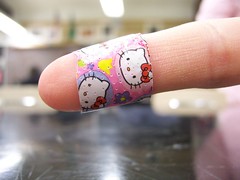
Hello Kitty BandaidSkinned knees heal.  Broken arms mend.  Wounded feelings and damaged trust don't often repair themselves as easily or reliably.

In business, as in  relationships, you cannot count on nature or time to heal wounds.  Despite the saying that time heals all wounds, smart  businesses seek out customers (or former customers) who are feeling wounded.  They seek them out and talk to them.

Talking to disappointed customers has many benefits:
  • You have an opportunity to right the wrong.  This can often turn a bad experience into a good one for the customer.
  • You learn quickly what isn't going right so you can address the problem before it disappoints more customers.
  •  By reaching out to customers, and making this a routine practice, you help to evolve your culture into one that is more caring and customer-focused.
  • After you have shown a customer that you care enough to learn about their problems and concerns and take steps to address them, you are likely to increase the loyalty of that customer.
  • You are also likely to turn negative word-of-mouth into positive testimonial.  This is powerful in two ways.  First you get someone talking positively about you and your brand.  Second, because negative word-of-mouth spreads many times faster than positive word-of-mouth, you stem a tide of mind-changing bad publicity.
Often times, when you take time to listen to customers' concerns, you will find that the problems are not ones that you were aware of before you listened.  And sometimes they aren't hard to fix.  Furthermore, you will find that most customers understand that you cannot change everything.  They will understand that even when you can change something, you might not be able to make the change in time to impact their personal experience.  They also understand that because you took the time to listen to them, that they are important to you.

I had a boss and mentor once who said that the customers who complained were our greatest friends.  "They are taking their time to tell us where we made a mistake and how we can get better.  We pay consultants lots of money for the same advice!"
Enhanced by Zemanta

Wednesday, March 6, 2013

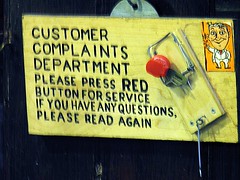
Press #@&^% for Customer Service

Customer services

Yesterday, I tried to get a simple question answered about a charge on my credit card.  I called the company issuing the charge with a straightforward request but one that didn't fit neatly into the categories provided on the charging company's voicemail system.

I am typically pretty willing to navigate through a voicemail system to find an answer to my inquiry.  I even find some of the more carefully constructed auto-response systems a pleasure to use as I can get an answer to my question quickly and with machine-like efficiency.

But this system was one of those circular machine hells that kept sending me back to the same place over and over and over and over again.  I tried calling back during normal business hours in the hope that I might be directed to a customer service agent.  No such luck.  I tried the website (as repeatedly suggested) but couldn't access the information I needed because I needed to have information that I could only get from the website in order to get into the website.  Or at least that is how I felt.

Ultimately, what started as a simple request for information about a charge from the issuing company ended up with me reversing the charges with my credit card company.  It also ended with me vowing to think twice or three times before doing business with that company again.

I understand that automated systems can save a company time and money.  I also understand that a poorly designed automated system can a company from having to deal with pesky customer problems and complaints.  But probably not in the way they intended.


The Many P's of Marketing: Pause

Pause:  I have had fun with the Many P's of Marketing and have more P-words to explore the breadth and depth of the world of marketing.  Nevertheless, I think it is a good time to pause this series and write about other things in this blog.  I will come back to it.  I will bring in more guest bloggers.  But for now, I have things to say that don't start with P!

Enhanced by Zemanta